
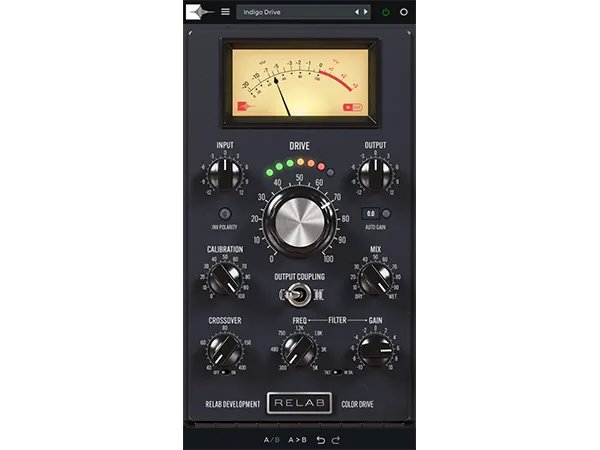
Relab Color Drive
Relab Color Drive: Real analog behavior, solved in real time. Color Drive is the Relab 176’s variable-gain tube circuit, with transformers and all. This is true hardware saturation in software form.
Electronic Delivery
PLEASE NOTE: This product is delivered via secure, electronic delivery. You will receive the full product license (with instructions) direct to your email. Enjoy a safe and fast way to get the latest version and full support direct from the manufacturer.
Description
Saturation built from a real-time circuit. Color Drive doesn’t stack algorithms or approximate “warmth.” It solves the Relab 176 tube stage, with the input transformer, 6BC8 variable-gain tube, calibration bias, and output transformer, as a single, living circuit. That’s why it behaves like hardware: every move changes the way the whole system responds. It’s hardware logic, in software form. Harmonics that feel alive, not static. Because the full circuit is solved in real time, density, tone, and transient shape interact exactly like they do in hardware.
Subtle or bold always musical. From barely-there warmth to real tube crunch, it can tuck transients, add harmonic weight, and give instruments presence without pushing them forward in level. If you’ve been waiting for a saturator that responds like real hardware, this is the one that finally does it. Drive, the heart of the tube stage: When you increase the Drive you’re not just adding “more effect” you’re pushing an accurate 6BC8 tube (and switchable output transformer) model inside a complete analog circuit. Harmonics build naturally, transients round in a controlled way, and the signal picks up that understated weight and glow you normally only get from real hardware.
True Hardware Saturation
Switch in the transformer, change the harmonics: Switching to transformer coupling inserts the Relab 176’s output transformer back into the signal path, completing the full analog chain. With Calibration centered, the stage produces mostly odd-order harmonics, adding focus, punch, and that familiar hardware solidity to a mix.
Bias the tube & tune the harmonics: Calibration adjusts the tube’s bias point, letting you introduce just the right amount of even-order harmonics when you need warmth or contour. Especially when paired with the output transformer, it becomes a precise way to shape the harmonic mix. You can create subtle, musical shifts that give you real control over how the color sits in a track.
Modern controls shape what the circuit hears: These controls let you decide how the signal enters the tube stage, not just how much. The low-end crossover can route the deep bass around the drive circuit so you keep all the weight without muddying the harmonics. And the pre/post tilt or high-shelf emphasis filters let you steer exactly which frequencies push the tube harder. Together they give you precise, musical control over the harmonic profile before any Drive is added.
Features
- Hardware-Accurate Saturation Behavior Every control affects the whole system, so tone, dynamics, and harmonics interact like real analog hardware.
- Musical, Responsive Harmonics Harmonics evolve naturally with signal level-never static-preserving realistic density, tone, and transient shape.
- Drive Control Based on a True Tube Stage Increasing Drive pushes an accurate 6BC8 tube model, producing controlled transient rounding, harmonic weight, and authentic tube glow.
- Switchable Output Transformer Engaging the transformer completes the analog chain, emphasizing odd-order harmonics for added punch, focus, and solidity.
- Tube Bias (Calibration) Control Adjusts the tube’s bias point to blend in even-order harmonics, allowing precise shaping from clean focus to warm contour.
- Advanced Input Shaping Controls Low-end crossover preserves bass clarity, while tilt and high-shelf filters let you choose which frequencies drive the tube harder for targeted coloration.
- Real-Time Circuit Modeling The entire Relab 176 tube stage (input transformer, 6BC8 tube, bias, output transformer) is solved as one continuous circuit, not stacked algorithms.
Tech Specs
MAC
OS X macOS 12 Monterey or higher
Memory: 8 GB
CPU: Apple Silicon M1 or newer
Plugins: VST-3, AU, AAX
WINDOWS
Windows Windows 10 and up (64-bit)
Memory: 8 GB
CPU: Intel Core i7 (8th-gen+) or AMD Ryzen 5 (3000-series+) with AVX2 support
Plugins: VST-3, AAX
* Any references to any brands on this site/page including reference to brands and instruments, are provided for description purposes only. For example references to instrument brands are provided to describe the sound of the instrument and/or the instrument used in the sample. Plugin Max do not have (nor do they claim) any association with or endorsement by these brands. Any goodwill attached to those brands rest with the brand owner. Plugin Max or its suppliers do not accept any liability in relation to the content of the product or the accuracy of the description.
Reviews
There are no reviews yet.