
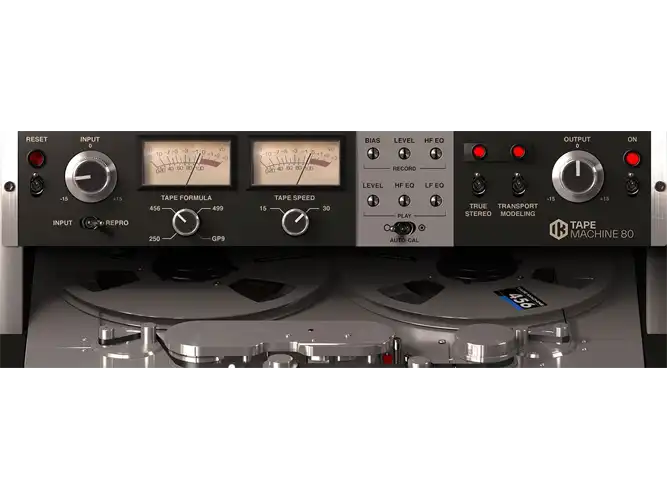
IK Multimedia Tape Machine 80
IK Multimedia Tape Machine 80: Re-live the magic of the Studer A80. When it comes to professional analog multi-track tape machines, there’s perhaps none more respected than the Studer A80.
Electronic Delivery
PLEASE NOTE: This product is delivered via secure, electronic delivery. You will receive the full product license (with instructions) direct to your email. Enjoy a safe and fast way to get the latest version and full support direct from the manufacturer.
Description
This Swiss machine became the universal standard for professional high-end multi-tracking, and now it’s available for you as the T-RackS Tape Machine 80. The A80 was produced from 1970 through 1988, and remained a studio staple throughout that time. In its various revisions, the A80 became an essential part of countless influential records, with a perfect blend between transparency and subtle harmonic enhancement. Using a careful mix of dynamic convolution and physical modeling, the Tape Machine 80 re-creates the complex interplay of effects taking place in the analog audio tape recording process, down to the finest detail.
Analog tape audio recorders are complex systems. They impart magic to the audio material, lifting the art within the music to a higher level. They add musicality to music. What a tape machine adds to the audio is the result of a number of interactions amongst several interdependent factors. More than just saturation, compression, or EQ alone, these factors work together, one affecting each other with the dynamics of music, adding a “movement” that goes into the soul of what we perceive. Decades of music produced on these pieces of artful human engineering have tailored the way we think music should sound. It’s imprint in our DNA. Trying to recreate this magic in the digital domain has been attempt since the early days of real-time audio plug-ins, with various degrees of success.
Features
Choose from 4 different tape formulations, each with its own unique tone:
- 250: Modelled after the 3M/Scotch 250 formula, it is the most colored of the four formulas. It went in production around 1974 and delivers a warm tone with slightly more distortion and saturation than the other formulas included in the package.
- 456: Modelled after the Ampex 456 formula, this model went into production around 1974. Perhaps the most widely used tape, it contributed the most to what is considered “the” tape sound. It offers a warm, round tone with a slight touch of saturation that greatly responds to the recording level.
- GP9: Modelled after the Quantegy GP9 formula, this tape accepts higher levels of signal with minimal distortion and compression. It’s very punchy and perfect for modern, high quality analog recordings.
- 499: Modelled after the Ampex 499 formula, this tape is designed to handle a great amount of level with minimal distortion and compression. It also exhibits added high frequency definition that makes it perfect for printing “digital-like” recordings, while still maintaining an analog sound.
Tech Specs
Mac
Minimal: Apple M1 or Intel Core i5 Processor, 8 GB of RAM, macOS 10.15 or newer. 9 GB of hard drive space. Requires an OpenGL 2 compatible graphics adapter.
Supported Plug-in formats (64-bit): Audio Units, VST 3, AAX.
Windows
Minimal: Core i5 Processor or equivalent, 8 GB of RAM, Windows 10 (64 bit) or newer. 9 GB of hard drive space. Requires an ASIO compatible sound card. Requires an OpenGL 2 compatible graphics adapter.
Supported Plug-in formats (64-bit): VST 3, AAX.
Reviews
There are no reviews yet.